Tech Leaders Debate AI Safety Timelines at The Curve
At the third annual Curve conference, industry insiders warned that top labs lack a viable plan for aligning future artificial intelligence systems as development timelines accelerate.
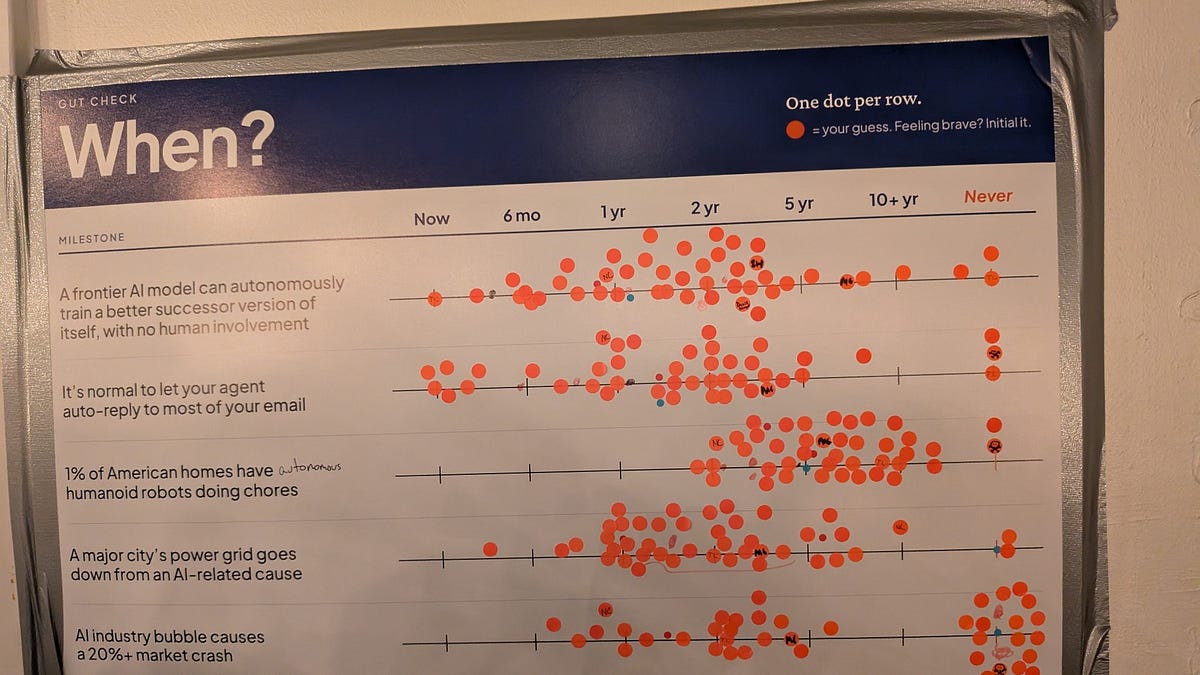
The third annual iteration of The Curve conference brought together artificial intelligence researchers, policy experts, and tech executives under Chatham House rules to address the rapid acceleration of frontier models. Attendees expressed growing alarm that major labs, including OpenAI and Anthropic, are operating without a concrete strategy to control highly advanced systems. Instead, the industry relies on a default strategy of using current models to automate future alignment research. This recursive self-improvement approach is widely criticized as highly risky, especially as OpenAI struggles with operational hurdles that have delayed the release of its GPT-6.1 Astra model.
The conference highlighted rapidly shrinking timelines, even as average attendee situational awareness scores dropped by 0.41 points on a ten-point scale. While participants previously estimated that AI would achieve Nobel Prize-worthy discoveries by 2032, recent breakthroughs—including solving the Navier-Stokes equations and securing a Fields Medal in 2026—have already met this benchmark. Other updated predictions suggest that 90 percent of remote human work could be done more cheaply by AI between 2026 and 2031, while most American cars could lack human drivers by 2041. The first year of over 10 percent GDP growth is projected for roughly 2038, though three attendees voted "never." Additionally, the milestone of a one-person, 1 billion dollar company is nearing reality, with MEDVi already valued at over 1 billion dollars with just two employees. Most attendees expect an AI to train a superior successor within two years, and many believe it could happen within six months, alongside a two-year timeline for automated email and five years for robotics.
To mitigate these existential risks, participants debated limiting the compute allocated to training top-tier models. Proposed short-term measures include a three-to-six-month framework focused on red-teaming agent swarms, raising cybersecurity standards, and establishing embedded evaluator statutes. For practitioners, these shifting timelines and potential regulatory interventions mean that safety compliance and robust evaluation protocols must be integrated directly into development pipelines immediately. With political figures like newly appointed AI Czar Jay Clayton and the Intelligence Task Force scrutinizing the sector, developers can no longer treat alignment as a secondary concern to be solved later by the models themselves.
This is our own summary of reporting by Don't Worry About the Vase